
Viola Davis, Jennifer Lawrence, Adam Sandler
Season 17 Episode 3 | 26m 40sVideo has Closed Captions
Viola Davis, Jennifer Lawrence, Adam Sandler, Brendan Fraser, Jamie Lee Curtis.
Viola Davis ("The Woman King") and Jennifer Lawrence ("Causeway") get honest about female action heroes; Jamie Lee Curtis ("Everything Everywhere All at Once") and Colin Farrell ("The Banshees of Inisherin") discuss their recent complex roles; and Brendan Fraser ("The Whale") and Adam Sandler ("Hustle") share their movie history and special connection.
Problems playing video? | Closed Captioning Feedback
Problems playing video? | Closed Captioning Feedback
Variety Studio: Actors on Actors is a local public television program presented by PBS SoCal
Viola Davis, Jennifer Lawrence, Adam Sandler
Season 17 Episode 3 | 26m 40sVideo has Closed Captions
Viola Davis ("The Woman King") and Jennifer Lawrence ("Causeway") get honest about female action heroes; Jamie Lee Curtis ("Everything Everywhere All at Once") and Colin Farrell ("The Banshees of Inisherin") discuss their recent complex roles; and Brendan Fraser ("The Whale") and Adam Sandler ("Hustle") share their movie history and special connection.
Problems playing video? | Closed Captioning Feedback
How to Watch Variety Studio: Actors on Actors
Variety Studio: Actors on Actors is available to stream on pbs.org and the free PBS App, available on iPhone, Apple TV, Android TV, Android smartphones, Amazon Fire TV, Amazon Fire Tablet, Roku, Samsung Smart TV, and Vizio.
Providing Support for PBS.org
Learn Moreabout PBS online sponsorshipElizabeth Wagmeister: Have you ever wanted to learn more about your favorite Hollywood stars?
Viola Davis: Every role you have the challenge is how do you get at the truth?
Elizabeth: Variety Studio invites you into the room with some of the biggest names in the business as they discuss their careers and critically acclaimed performances.
With Viola Davis and Jennifer Lawrence, Jamie Lee Curtis and Colin Farrell, and Brendan Fraser and Adam Sandler.
♪♪♪ Elizabeth: Welcome to Variety Studio, "Actors on Actors."
I'm Elizabeth Wagmeister.
Clayton Davis: And I'm Clayton Davis.
And we're taking a look back at some of the best recent movie characters and the accomplished actors who brought them to life.
Two Academy Award-winning superstars, Viola Davis and Jennifer Lawrence, talk about the dynamics and emotional challenges of their latest pivotal roles.
Viola Davis becomes a full-on action star as the leader of an all-female group of warriors, taking on physical and dramatic demands in "The Woman King."
female: Aghhh!
Nanisca: When it thunders, our ancestors demand we rip the shackles of doubt from our minds and fight with courage.
We fight not just for today but for the future.
Clayton: Jennifer Lawrence goes deep into the mind of a US soldier who experiences PTSD after suffering a traumatic brain injury in combat.
"Causeway" stands as one of her most daring performances yet.
Lynsey: I should be getting back anyway.
Sharon: Back home?
Lynsey: No, back to work.
Redeploy.
Sharon: You've made a lot of progress, but you're not ready to go back to work, not nearly.
Lynsey: Then what the hell is the point in all of this?
Jennifer Lawrence: This is truly the biggest honor-- Viola: Oh man, right back at you.
Jennifer: Your performance in "Fences" changed my life.
I think "Woman King" is the best movie I have seen this year, hands down.
And I heard an interesting story about how it even came to you 'cause you're a producer so I'd love to hear the story of Maria Bello pitching you the movie.
Viola: Well, Maria Bello presented me with an award at the Skirball Institute and, instead of presenting it traditionally, she pitched the idea of this movie, which she had written a treatment for and was trying to sell it around town.
She pitched it to the audience and she said, "Wouldn't everyone want to see Viola in "The Woman King"?
And I remember that was the moment I thought to myself, "Sit down.
It's just never gonna happen."
I mean, we all know that-- Jennifer: And why did you think that, because-- Viola: To be perfectly honest, with me, I'm a black actress and who's--what studio is gonna put money behind it?
How are they gonna be convinced that black women can lead a global box office and, of course, with "Woman King" I was 56 when I started training for it for 8 months.
So, yeah, I said, "That's not gonna happen," because you don't see it.
Jennifer: Yeah, I remember when I was doing "The Hunger Games," we were told, "Girls and boys can both identify with a male lead, but boys cannot identify with a female lead."
And it just makes me so happy every single time I see a movie come out that just blows through every single one of those beliefs, and to watch you at the helm and, my God, some of those action shots where the stakes were so high and you just, poof!
You just are amazing.
Viola: So I wanna know about "Causeway."
I wanna know what drew you to the story.
Jennifer: In retrospect, I think working through childhood trauma and accepting that it will always kind of be a part of my life, that it will always kind of be a negotiation when something hits me sideways and I'm not quite sure why it makes me feel that way.
And that feels alienating.
When I read "Causeway," even though the situations could not be more different, I'm not a hero who's risking my life to save my country at all.
I am an actor.
But the idea of carrying this invisible injury, of knowing that he healing is not linear and that there is so much progress and then there is a step back, and there's so much progress and then there's a step back.
And if I can see another person going through it and I can have empathy for Lynsey and I can have empathy for that character, then I can kind of start to understand how maybe I could feel empathy for myself.
And so it really was just--it was such a healing process that I think that's why it's still so hard for me to understand that people, like, like it or--I don't know, just even then it's like a movie.
It's so--'cause it was so personal for so long.
Viola: It's supposed to be personal.
Listen, what we do as actors helps people feel less alone.
And so, every role you have, the challenge is how do you get at the truth and this is a question for you.
You go into the action genre, it's just really interesting how human beings work.
If I were to play a character that were, say, I'm just gonna throw something random out there, a drug addict.
And so I decided to lose some weight, you know, so my cheeks can be more gaunt and my face can look more gaunt, and I think that when people see performances like that they see this transformative, people have to look at it and see that that's wonderful and terrific work.
When you do an action movie, for instance, and the word "action" is in front of it, there is something that brings it down a peg from artistic merit.
I did the weight training 5 hours a day, 6 days a week for 3 months at 56.
I did all the training for 5 months on the ground in the jungles of Africa and then you get to do the dialect work and then you have to do the emotional work.
But somehow, that is seen as just commercial.
There is the business aspect of what we do, the image.
But when you get to the set, that's not what it's about.
It's about figuring out how to make the character work and having the tools to be able to do that.
And I wanna know how much of the business has infiltrated your love of the work.
Jennifer: I mean, when "Hunger Games" was out, I couldn't really be an observer of life because everybody was observing me and I could feel my craft suffering, I could feel my antennae for the business side suffering, and I didn't know how to fix it.
I was--I think I was scrambling trying to fix it by saying Yes to this movie and then trying to counteract it with that movie and then not realizing that what I had to do was no movies until something spoke to me and I took years away.
I read "Causeway" and that was the first time I kind of started to feel like I got that voice back.
And I also find even on projects that I'm producing, it changes depending on the project and depending on the director.
I've been on a film that I'm producing where I can tell that's not what the--the director wants freedom, the director wants protection from the studio which I can give as a producer with being the actor.
If you don't wanna shoot that scene, I can go, "I'm not shooting that scene.
I just won't come out of my trailer," you know?
I got this be the bodyguard for the director.
You know, I feel like my process would change depending on who my co-star was and what we were building together.
Viola: Yeah, absolutely.
I have to say that the business is probably one of the biggest sort of offenders of my love of the work.
Jennifer: It's interesting that you say the business is the biggest hindrance.
For my experience, the biggest hindrance to my craft has been press.
Every time I do an interview I just think, "I can't do this to myself again."
And it's so antithetical to what I do.
I'm supposed to be a mirror.
I'm supposed to be a vessel, especially something like "Causeway."
It ended up being all of our diaries, I mean, all of us have blood in that movie, and it felt so personal to me and the idea of sitting down and telling people to, like, "Go see it," you know, "stream it.
Please go watch it," just feels so wrong.
I feel immediately defensive, like, "Well, don't watch it if you don't think you're gonna like it," or you know, like, this is my diary, so either read it or don't read it.
I don't care.
♪♪♪ Elizabeth: Jamie Lee Curtis and Colin Farrell sit down for a candid conversation about their latest roles, and as quick as they will make you laugh in these films, they can just as easily break your heart.
Jamie Lee Curtis, the screen queen herself, takes on a new type of horror as an IRS agent in "Everything Everywhere All at Once," delivering a performance that surprises audiences with perfect comedic timing and high-flying kicks and a martial arts "drama-dey."
♪♪♪ Elizabeth: Colin Farrell delivers the performance of his career as the needy part: a man trying to win back a friendship in "The Banshees of Inisherin."
Pádraic Súilleabháin: Man, if I said something to you, maybe I said something when I was drunk and I've forgotten, but I don't think I said something when I was drunk and I've forgotten it, but if I did then tell me what it was and I'll say sorry for that too, Colm.
With all my heart, I'll say sorry, just stop running away from me like some fool of a moody schoolchild.
Jamie Lee Curtis: Hi, Colin Farrell.
Colin Farrell: Hi, Jamie Lee Curtis.
Jamie: How are you?
Colin: I'm good.
How are you doing?
Jamie: We met once before, in Dublin.
My daughter and I were in Ireland.
She was retracing her genealogic roots and we went to Ireland and we were taking votes about all of the places we were and sort of combining, well, Spain had the best architecture, you know, and the best people were from Ireland.
Colin: That's lovely, isn't it?
Jamie: They were the nicest people we met.
Colin: There's an element that I'm in Ireland now waiting for me to return.
It's like, there's so much residual energy of mine there.
The place shaped me, you know, it formed me, chiseled me, and sent me out into the world.
Jamie: No, but the movie is so much about Ireland.
Colin: Yes, is.
Jamie: It's such an Irish movie.
It's so simple and profound.
Colin: Martin's extraordinary.
When people heard that the film was about two friends falling out, like, literally, one lad saying to another lad within the first 5 minutes of the film, "I don't want to be your friend anymore," and that's it.
Today's culture you just don't bother sending a text.
I believe the kids call it "ghosting."
You just cut the person out.
Jamie: You just stop.
Colin: You just stop.
Hard to do that on an island where there's one pub and one church in 1953.
Jamie: And it's a very clear statement from him.
It's so confusing and confounding and understandable in what he's trying to say.
Colin: It is.
I was shocked by how much--and it's a testament, of course, to Martin's writing but also Brendan's brilliance and his depth as an actor and an artist and a musician, and just a man of unfathomable depth, you know, that I sympathized with his character when I watched the film.
The length that he had to go to find this peace, this solitude, that he could reckon with his own mortality.
Jamie: That resonated so deeply.
Colin: Did it really, love?
Yeah, yeah.
Jamie: Well, because ultimately you're gonna have to say to some people, "I don't wanna be your friend anymore."
You're gonna have to because in order to be able to separate from people.
Colin: Everyone pays for that, whether you're the dumper or the dumpee.
The separation of church and state, that signifies the dissolution of a friendship, is always going to be painful.
Jamie: But leaving somebody behind for a reason.
Colin: It's essential.
I totally agree with it.
Jamie: It was for--he was going to die unfulfilled, unexpressed-- Colin: Absolutely.
Jamie: --if he stayed in this relationship.
Colin: That's why I sympathized with him.
Jamie: And I understand.
I sympathize with him too, and yet your wide open, not understanding, it's so powerful, because it doesn't connect such a beautiful intensely quiet, conversational movie about human emotions and ours is a movie about-- Colin: Well, yours is about the exact same thing.
It's not, of course it is, and they all are.
I know there's an argument for that.
With yours it rides me at a moment's deep emotional reckoning and peace.
The chaos and the movement and the tumult of your film and you're extraordinary in it and the film is extraordinary.
I'd heard so much about it.
These filmmakers seem to be interested in your lads, the themes that we, whether we're conscious of it or not, we all really struggle with, themes of loneliness, themes of purpose.
In your film, regret was such a big thing.
Jamie: It's funny when you know someone.
I know so many women like Deirdre Beaubeirdre.
I know them.
Colin: Really?
Jamie: I do.
I've met them.
Colin: Who are they?
How do they present themselves in their lives?
Jamie: I've met them in recovery.
People who wield power in their job as a replacement for having any love or affection or that no one recognizes them anywhere other than in their position of power, that that is the only thing that they've spent their life nurturing so that that's what gets them off is that power.
And then what happens to them at the end of the day when they go home and they sit alone in their apartment.
It's incredibly sad and so she, as much as I completely knew her, like, from the first 95% of my work in that movie was shot in the first 2 days.
Colin: Really?
Jamie: Mm-hm, in that office building.
Colin: Did it hurt you, the film in a way--not in a bad way.
Did it haunt you, did it-- Jamie: What surprised me was when we did the hot dog universe, 'cause both of our movies involve fingers and hands.
Colin: Yes, digits, yes, indeed.
Jamie: Digits.
You know, I didn't understand much of it and I was trying to figure it out, and then we went into the set and what happened, which was so beautiful, was Michelle and I just found this gorgeous emotional place with each other.
And there was no dialog and it was written that we were breaking up in this universe.
The scene ended up becoming an improvisation about a loofah that Deirdre was saying to Evelyn that although she bought the loofah in the relationship, she was leaving it because Evelyn had used it more than-- Colin: Ah, gorgeous.
Jamie: It was just-- Colin: Gorgeous.
Jamie: --beautiful dance with her.
And that's--that level of finding reality within a universe that looks so bizarre, and yet it's not bizarre at all.
You see the movie and you believe everything about it.
Can we talk about the donkey please?
Colin: Yeah, Jenny.
Yeah, go on.
Jamie: Tell me about her.
Colin: Jenny was lovely.
Jamie: Tell me about her 'cause she's so beautiful.
Colin: It's her first film.
She's gorgeous.
Jamie: She's gorgeous.
Colin: She's gorgeous but she was also a bit of a nervous wreck, which is understandable 'cause film sets, if you don't know what you're doing, can be a very awkward place to be.
So she was very--when she arrived, she was-- she actually had a--she had a support donkey.
She did.
She had a support donkey, and I'm so ashamed I don't remember the support donkey's name.
I do, I do.
Rosie.
Rosie was Jenny's support donkey, right?
So Jenny was the star.
Rosie was her support donkey.
They called Rosie Jenny's quote, unquote, "stand-in."
Jamie: Oh, I see.
Colin: And she did sometimes, but literally, Jenny would be always looking to see where Rosie was, and Rosie had a little kind of a peaceful effect on her constitution.
You could see it.
But it was an amazing--it didn't feel like work.
As upsetting as it was to tell the story sometimes, it was such a privilege to share it together, all of us in front of and behind the camera.
And there was support everywhere you looked, and there was laughter everywhere you looked.
And there was sunrise every day outside that pub, Jonjo's pub.
We'd all just walk out as the sun was setting, just sat there in silence for 8 to 12 minutes every day the sun set and then we'd all 50 of us turn around and go back into the pub and continue shooting.
It was unspeakably beautiful if I'm honest, I have to say.
♪♪♪ Clayton: It was in 1994 when Brendan Fraser and Adam Sandler worked together in the comedy cult classic, "Airheads."
And now, nearly 30 years later, the two have redefined their careers and are rocking in an incredible second act.
Brendan Fraser doesn't only rely on prosthetics to become Charlie, a 600-pound man desperately trying to reconnect with his daughter in "The Whale."
Charlie: Do you ever get the feeling that people are incapable of not caring?
People are amazing.
Clayton: Adam Sandler has countless memorable roles on his résumé.
With his latest as Stanley Sugerman in "Hustle," he plays a basketball scout and coach trying to recruit a new player, adding yet another instant classic to his repertoire.
Stanley Sugerman: You know what?
I have been in this league for 30 years and it's like I'm nothing.
It's like I wasn't even here.
Adam Sandler: When I first met Brendan Fraser who we're talking--that's your full name, right, Brendan Fraser?
Brendan Fraser: It's Fraser.
Adam: Fraser.
Brendan: Like the thing you shave with, a razor.
You should try standing closer to it, I note.
Adam: I didn't even know this happened.
I mean, this is 2 days.
Two days of not shaving.
But Brendan, you were in a movie called "Airheads."
You were the leader of the band.
Brendan: Of The Lone Ranger.
Adam: The Lone Rangers, Rangers?
Brendan: That was a joke in the movie.
You pluralized them.
Adam: That's right, the Lone Rangers.
But that was one of the best shoots of my life, without a doubt.
Brendan: Wasn't it great?
Adam: It was the best.
Brendan: Just up all night for weeks on end.
Adam: All of us were young.
Brendan: We jumped off the parking structure.
Adam: Buddy, that was incredible.
Brendan: Getting crowd surfed.
Adam: Now, this is the truth on that jump.
We jumped off the thing, landed on a mat maybe 15 feet below us, right?
Not that big of a stunt.
I landed in such a stiff way that I heard my neck go "ka-ka-ga." I heard everything, but I didn't want to-- Brendan: You didn't want to say anything about it.
Adam: I couldn't say anything because I would be humiliated.
You two guys got up, laughing, you and Buscemi.
I'm not good at jumping and landing on my back.
Brendan: Don't do that.
Adam: I gotta stop.
Brendan: Take it from me, okay?
The guy who smashed into trees for a living for a while.
Adam: Yeah, that's true.
You went on to do so many--you went on, first of all--first of all, I saw "The Whale."
I was just really, my heart was broken throughout the whole movie, and what did you have on?
Because your hands were big.
Brendan: Those are like sleeves that came to the shoulder.
There was a five-point harness that had me strapped in pretty--you know, once into it, I was in there all day until it came off.
But the rule was with this, is that the whole look should obey the laws of physics and gravity 'cause we don't see that in films and I really looked, I really looked, I looked at what the Farrelly brothers did, I looked at what Mike Myers did, I looked what Eddie Murphy did, and that's just in the last 20 years.
Anything before then, it's a cut-out silhouette of a costume that's stuffed with, like, batting and if you're normally just an athletic actor inside, the silhouette of a suit and it was all in service of just, you know, kind of a mean joke or a one note sort of shtick that I think we're better than.
There are those who live with this disease and it was my obligation to be their voice and to be as honest as I could and as authentic as I could in the portrayal of this.
Look, my weight has been all over the map.
I was muscular guy for "George of the Jungle."
I put on weight to play this role and it wasn't enough, so the body had to go on top of that.
And the two worked together, because it's in service of the story that we're telling and then, turned out to the build site which is a two-bedroom apartment and it was shot during the time of COVID.
We were all there, and it was tenuous.
Did you work during--when COVID was happening?
During the lockdown?
Adam: I did the movie "Hustle."
Brendan: You shot "Hustle" during COVID?
Adam: Yeah, we shot at two different times.
We shot 6 weeks of shooting, Jeremiah Zagar, he's the director, he's tremendous.
We kind of worked on the script with Will Fetters, all on Zoom, and then just like you, it was about--it was shooting during COVID.
We had to--it was a basketball movie.
They weren't allowed to play basketball yet.
Couldn't have guys sweating on each other, couldn't let that happen.
So we shot about 5 or 6 weeks of every scene that wasn't basketball, then we came back and the NBA was available.
The guys were available to come shoot, and then we shot the basketball stuff after that.
Brendan: What was it like working with the ball players?
I mean, insofar as, like, I'm sure it was the best 'cause they're performers in their own regard.
Adam: Oh yeah, man, there's complete confidence.
Jeremiah was running the show and it was just about telling the players, "Just say what you would say if you guys hated each other or if you guys were teammates or whatever it was."
Brendan: 'Cause you're a sports scout, what's his name again?
Adam: Stanley Sugerman.
Brendan: Okay, so Stanley went into the wilds and you found him in Spain, this kid.
Adam: Yes, yes, Juancho Hernangomez, amazing guy.
I love this kid.
He's a sweetheart, and I think as-- Brendan: When you're asking him, "Do you love-- or are you obsessed with basketball?"
Adam: Yeah, right.
That, to me, was awesome to say out loud because when I was young, similar to what I was saying to Juancho's character, I was saying, "I don't think of nothing else except comedy, about getting as good as I can be, and that's all," and-- Brendan: Was there a mentor who came to you in that way and said, "Are you for real?
Are you playing with me?"
Adam: I tell you what.
There wasn't a guy who gave me a speech like that.
I had my own crazy thing in my head.
I made promises to myself.
I said, "Don't give up."
Brendan: Well, your dad had a lot to do with this.
Adam: And then my dad, yeah, of course.
My dad was my coach in every sport.
Brendan: But he wasn't as confrontational as Stanley was.
Adam: No, you know what he was, my dad?
He was amazingly calm with giving me confidence.
It's the same thing when I do stand-up.
If I walk out confident, we're gonna have a good show.
If I walk out with some fear in my head and they see it-- Brendan: Does it fuel you a little bit, though?
The fear like that, you know?
Adam: The fear in the daytime before the show is probably a good thing.
Then when you get out there, if you show too much fear, the audience is, like, "What's going on, man?
We're here to have a good time.
What are you all tense about," you know?
And it's not a guarantee.
Just like "Saturday Night Live" when they bring you out.
How did you go out, by the way, on SNL?
Do you remember?
Brendan: I went out in an out-of-body experience.
Adam: Yeah, right, yeah.
Brendan: And I learned that the show was pretty much about changing clothes.
Running around in the dark while people pull your clothes off and put new ones on.
Adam: That's true.
I actually was at "Saturday Night Live" on a show and I saw Darren and maybe just at the beginning of you guys starting to shoot or you guys just talked and he said, "I'm doing a movie," and he mentioned what he was doing and he said, "You know the guy I cast as Charlie, the lead guy."
I said, "Who?"
And he said you and I said... and he goes, "Yeah, you get it."
I 100% knew you would crush this.
And I love you and I just loved your performance.
You made me--I just--'cause you're my buddy.
Brendan: Thank you, Adam.
♪♪♪ Clayton: We hope you've enjoyed our look inside Variety Studio "Actors on Actors."
Elizabeth: Please join us again next time.
Viola: I think that's why people are moved by your performances.
That's what I'm gonna say.
Jennifer: Goodbye.
I believe you.
Jamie: And it's a game.
I don't give a--oh, sorry, can't say--PBS.
Colin: Done.
Too late now.
Adam: Ladies and gentlemen, Brendan Fraser.
How do you say it now?
Brendan: Fraser, like the-- Adam: I'm gonna say Fraser anyway.
Let me say Fraser.
Brendan: Get a shave.
Adam: But I don't wanna-- Brendan: You know what?
Nobody's ever got my name-- Adam: Brendan Fraser!
See, it didn't sound right.
Brendan: It felt good, though.
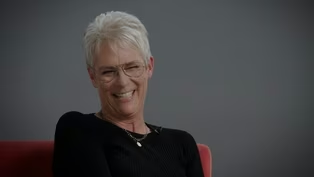
Viola Davis, Jennifer Lawrence, Adam Sandler (Preview)
Video has Closed Captions
Preview: S17 Ep3 | 30s | Viola Davis, Jennifer Lawrence, Adam Sandler, Brendan Fraser, Jamie Lee Curtis. (30s)
Providing Support for PBS.org
Learn Moreabout PBS online sponsorship













Support for PBS provided by:
Variety Studio: Actors on Actors is a local public television program presented by PBS SoCal